GFN-FF#
A general force field for elements Z = 1–103.
A standalone library implementation of the GFN-FF method by S. Spicher and S. Grimme,
adapted from the xtb code (most recently at commit
6d44803 and validated against that version’s results).
It is meant to be linked into other Fortran, C, and C++ projects, and it also ships Python bindings.
From this point forward, development may diverge from the upstream xtb implementation.
As of version v0.3.0 of this repository divergence is the case in order to add analytical Hessians and other features.
GFN-FF (Geometries, Frequencies, Non-covalent interactions Force-Field) is a completely automated, topology-based force field for fast structure optimisations and non-covalent interaction energies. The topology and parametrisation are derived entirely from the input geometry, without user-defined atom types or connectivity.
Quick start#
pip install "gfnff[ase]"
from ase.build import molecule
from gfnff import GFNFF

atoms = molecule("caffeine")
atoms.calc = GFNFF()

energy = atoms.get_potential_energy()   # eV
forces = atoms.get_forces()             # eV / Å
The same install provides a command-line tool:
gfnff molecule.xyz --opt --alpb h2o
Documentation#
The documentation is hosted at https://pprcht.github.io/gfnff/. It contains the guides listed below and a Python API reference generated from the docstrings.
Topic |
Page |
|---|---|
Fortran, C and C++ interfaces, periodic systems, use as a CMake or Meson subproject |
|
Python: installation, command-line tool, |
|
Force-field versions, |
|
Benchmarks and choice of BLAS backend |
|
TOML parameter file format |
|
Python API reference |
Building from source#
The library requires a Fortran and C compiler (e.g. gfortran/gcc),
LAPACK/BLAS (e.g. OpenBLAS), and optionally OpenMP.
Both CMake (≥ 3.21) and Meson (≥ 0.59) are supported.
CMake |
Meson |
|
|---|---|---|
Build |
|
|
Test |
|
|
The compiled library (libgfnff.a by default) is placed in the build directory
and can be linked into any downstream project.
Using the library#
Initialise a calculator once (topology setup, the expensive step), then call the singlepoint routine as often as needed:
use gfnff_interface
type(gfnff_data) :: calc

call calc%init(nat, at, xyz, ichrg=ichrg, iostat=io)
call calc%singlepoint(nat, at, xyz, energy, gradient, iostat=io, sigma=sigma)
call calc%deallocate()
Coordinates are in Bohr, energies in Hartree, gradients in Eh/Bohr.
The C/C++ header include/gfnff_interface_c.h mirrors these calls;
see docs/library.md.
Performance#
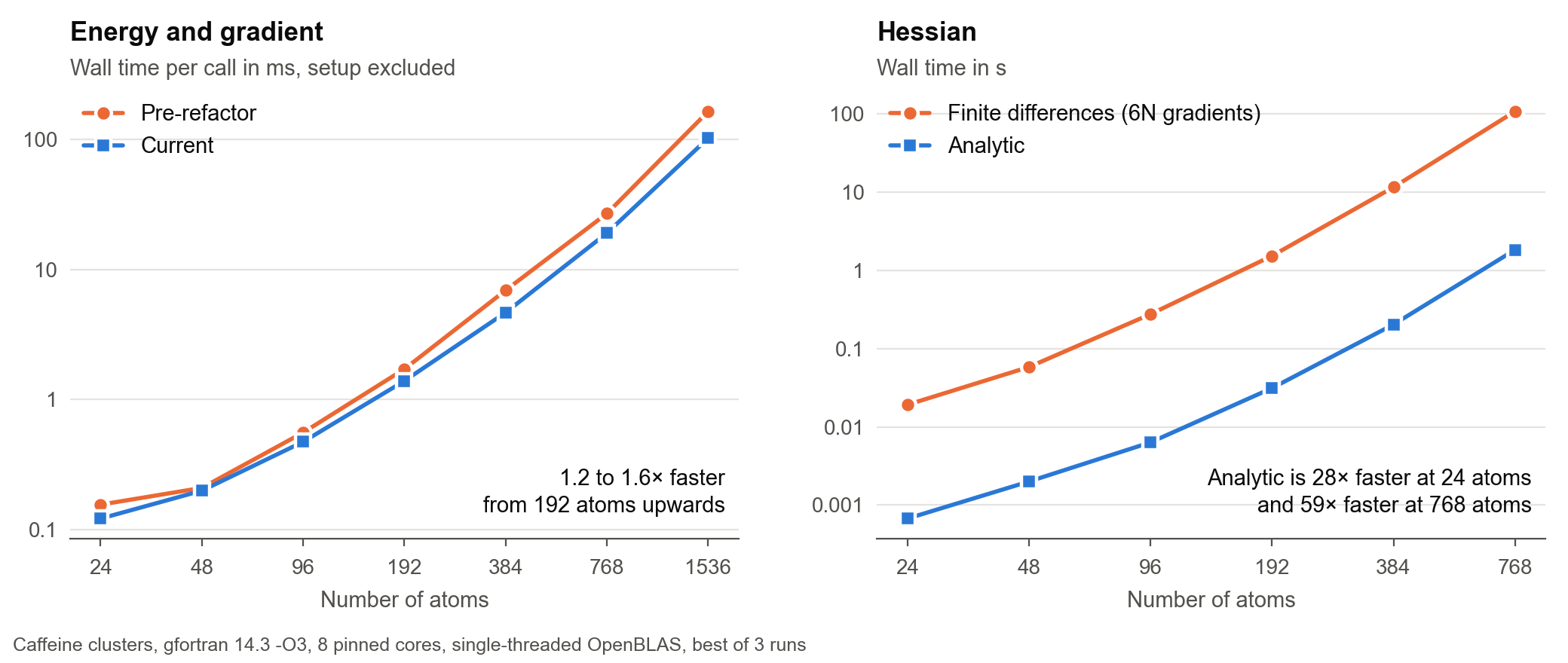
Caffeine clusters from 24 to 1536 atoms on 8 cores. Energy and gradient are 1.2–1.6x faster than the pre-refactor code from 192 atoms upwards, and the analytic Hessian is 28x (24 atoms) to 59x (768 atoms) faster than finite differences. Hessian speed depends mainly on the BLAS backend; details are in docs/performance.md.
References#
Molecular GFN-FF, a generic, partially polarisable force field covering organic, organometallic, and biochemical systems: S. Spicher, S. Grimme, Angew. Chem. Int. Ed. 2020, 59, 15665. doi:10.1002/anie.202004239
Periodic boundary conditions and molecular crystals, with adjusted non-covalent interactions for lattice energies and unit-cell optimisations: S. Grimme, T. Rose, Z. Naturforsch. B 2024, 79, 191. doi:10.1515/znb-2023-0088
Lanthanide and actinide extension, a reparametrised f-element treatment: T. Rose, M. Bursch, J.-M. Mewes, S. Grimme, Inorg. Chem. 2024. doi:10.1021/acs.inorgchem.4c03215
License#
This project is licensed (as the original xtb code) under the GNU Lesser General Public License v3 or later.
See LICENSE for details.